
When reducing makes sense
- Your business profits or rental income are falling.
- You stopped self-employment or sold a rental property.
- More of your tax will be taken through PAYE.
- You are making bigger pension contributions or Gift Aid donations.
Payments on account are based on last year. If this year’s income is clearly lower, paying the full amount means HMRC holds your money until you file. See how payments on account work.
Three ways to reduce them
| Way | When to use it |
|---|---|
| On your tax return (SA110) | When you file, for next year’s payments on account |
| HMRC online account | Any time before the bill is finalised, if you manage your own Self Assessment online |
| Form SA303 | By post, or if you cannot use the online service |
How to reduce them on your return in Self Assessment Software
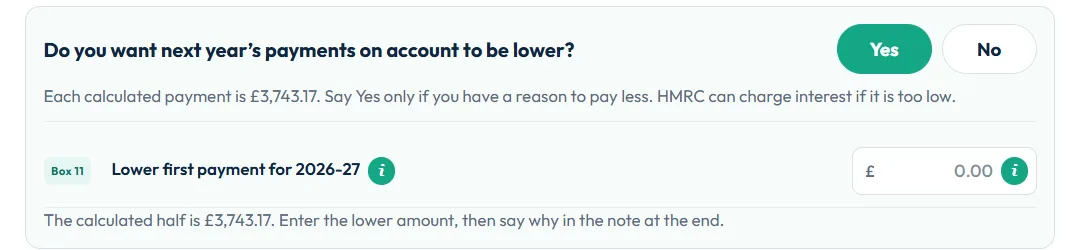
- Open the SA110 pageIn your return, open the SA110 tax calculation page.
- Answer the questionDo you want next year’s payments on account to be lower? Answer yes (box 10).
- Enter the lower amountIn box 11, enter the lower first payment for next year. The second payment matches it.
- Say why in box 17Write the reason in the box 17 note. It is required: HMRC needs that note.
- Check the payment noteThe payment schedule then says payments on account have been reduced on SA110 (box 10).
The interest risk
If you reduce your payments on account and your actual bill turns out higher, HMRC charges interest on the difference from 31 January and 31 July, as if you had paid late. Use a realistic estimate rather than reducing to nil.
Reduce to nil only if you are confident no tax will be due, for example you stopped trading and all your income is now taxed through PAYE.
Still stuck?
- Not sure of next year’s figure? Estimate cautiously; a small overpayment is refunded.
- Box 17 note missing? HMRC needs the reason. The page will not let you leave it empty.
- Already filed? Reduce online in your HMRC account or with form SA303.
Still not sorted? Contact us and tell us the page, the tax year and any message you see.
Questions answered
Can I reduce my payments on account?
Yes, if you expect your next tax bill to be lower. You can do it on your tax return, in your HMRC online account, or with form SA303.
What is form SA303?
SA303 is HMRC’s paper form to apply to reduce your Self Assessment payments on account.
What happens if I reduce them too much?
HMRC charges interest on the difference from the original due dates.
Can I reduce payments on account to zero?
Yes, if you expect no tax to be due through Self Assessment. Only do this if you are confident, as interest applies if you are wrong.
Do I need to give a reason?
Yes. HMRC asks why you expect the bill to be lower. On your return the reason goes in the box 17 note.
Official sources
These guides explain how HMRC's rules apply in Self Assessment Software. Check GOV.UK for your own circumstances.