
Payment dates for 2025-26
| Date | What is due |
|---|---|
| 31 January 2026 | First payment on account for 2025-26 |
| 31 July 2026 | Second payment on account for 2025-26 |
| 31 January 2027 | Balancing payment for 2025-26, plus the first payment on account for 2026-27 |
| 31 July 2027 | Second payment on account for 2026-27 |
A worked example
Alex’s 2025-26 tax bill is £4,000. Their payments on account for 2025-26 were £1,500 each (based on £3,000 for 2024-25), so they have paid £3,000.
| By 31 January 2027 | Amount |
|---|---|
| Balancing payment for 2025-26 (£4,000 − £3,000) | £1,000 |
| First payment on account for 2026-27 (half of £4,000) | £2,000 |
| Total to pay | £3,000 |
Then £2,000 by 31 July 2027 for the second payment on account.
Why the first year feels so expensive
In your first year of Self Assessment you have made no payments on account. So on 31 January you pay the whole bill for the year plus half of it again as the first payment on account for the next year: 150% in one go. Plan for it, especially in the first year of self-employment or letting.
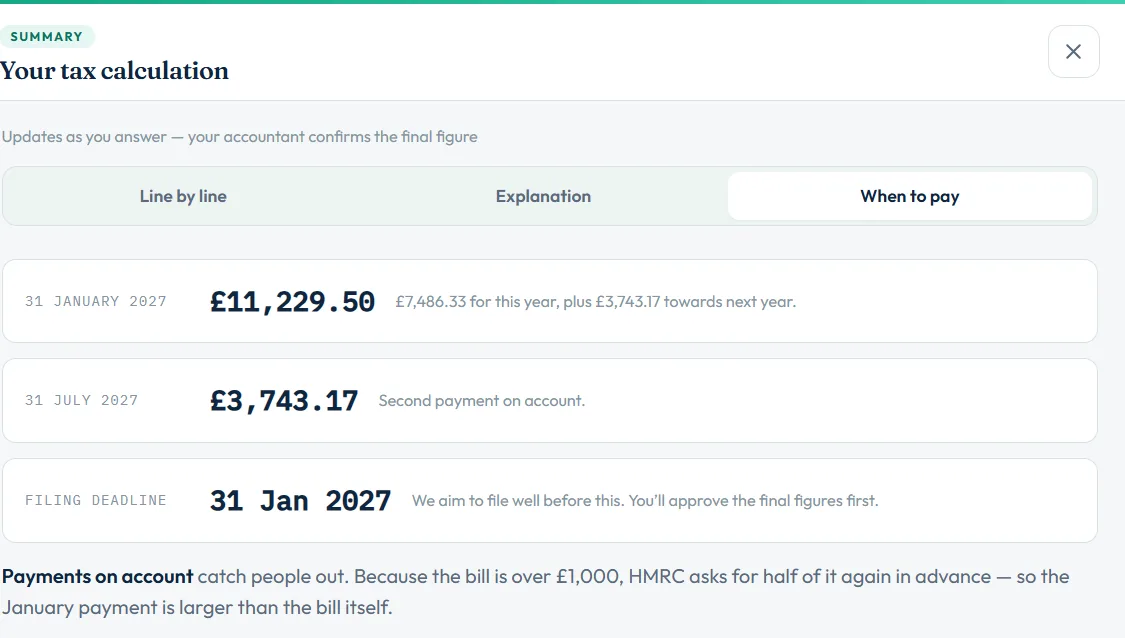
Because the bill is over £1,000, HMRC asks for half of it again in advance, so the January payment is larger than the bill itself.
See your payments in Self Assessment Software
- Open the calculationIn your return, choose See the full calculation.
- Choose When to payThe When to pay tab shows what is due on 31 JANUARY, including the amount towards next year, and on 31 JULY.
- Get the payment noteAfter filing, the payment note What to pay HMRC lists payments already made, the balancing payment and each payment on account.
If your income is going down
If you expect next year’s bill to be lower, you can ask to reduce your payments on account. See how to reduce your payments on account. If you reduce them too much, HMRC charges interest on the shortfall.
Still stuck?
- No payments on account showing? Your bill may be £1,000 or less, or 80% or more was taxed at source.
- January figure much higher than your bill? It includes next year’s first payment on account.
- Already paid some tax for the year? Check it is entered so the balancing payment is right.
Still not sorted? Contact us and tell us the page, the tax year and any message you see.
Questions answered
What are payments on account?
Advance payments towards your next Self Assessment bill. There are two each year, usually each half of your previous year’s bill, due by 31 January and 31 July.
When are payments on account due?
By 31 January in the tax year and 31 July after it ends. For 2026-27 that is 31 January 2027 and 31 July 2027.
Who has to make payments on account?
You do if your last Self Assessment bill was more than £1,000, unless at least 80% of your total tax was already deducted at source, for example through PAYE.
Are capital gains included in payments on account?
No. Capital Gains Tax and student loan repayments are not included. They are paid in full by 31 January after the tax year.
Why is my first Self Assessment bill so high?
In the first year you pay the full bill plus the first payment on account for the next year, so the 31 January payment can be 150% of the bill.
What if I pay too much on account?
If your actual bill is lower than the payments on account, HMRC refunds or credits the difference after you file.
Official sources
- GOV.UK: Understanding your Self Assessment tax bill: payments on account
- GOV.UK: Pay your Self Assessment tax bill
These guides explain how HMRC's rules apply in Self Assessment Software. Check GOV.UK for your own circumstances.